

I may well be the only one who has noticed this, but the common theme of all my posts here — basically — is pitching rationalist stuff to right wingers. This is my first time trying it the other way around. Or is it. LOL
Anyway I wrote this to Cowen
Hello Patrick and Tyler,
This is Stevie Miller. Tyler may remember me as an EV fellow from a few months ago who interned at Works In Progress, though I’m sure there are lots of EV people these days. My day job is being a statistics and machine learning undergrad at Carnegie Mellon. I also took a gap year from 2023-24 to work for Curtis Yarvin, though my politics have since become more conventional. I blog at rightrationalism.art.
Firstly, I want to thank you both very much for undertaking this stupendous grants program. The Works in Progress set, Sam Hughes in particular, have perhaps been the only people thinking seriously about the threat of an ugly future. As Hughes notes in his magisterial Making architecture easy:
Imagine if atonal music were played on loudspeakers across the towns and cities of the country. The vast majority of it was not written by gifted composers, such as Arnold Schoenberg, but by commercial muzak producers, so even when one troubled to listen carefully to it, it would rarely be of any interest. Everywhere someone went, except indoors and in the countryside, this disconcerting sound would follow them, making every street and square into a slightly uneasy and alienating place. The citizens of such a country would tend to flee its public spaces; the countryside would be intensely valued for its ‘quiet’; its cities would struggle perennially against decline. Substitute architecture for music and, it seems to me, a little like the world we actually live in.
There are many problems in the world, and I think a good acid test for whether they are worth considering is “Could this conceivably be an Effective Altruist cause area?” Hughes’s thought experiment demonstrates that you really can make the case that our society’s beauty problem has costs in the hundreds of billions, and contributes to historical trends one can see in the data.
It’s so heartening that this nascent cause area is now unambiguously larger than Sam Hughes!
This raises the question: Might we now be entering a period like when AI safety was just Eliezer and his friends? The birth of a new cause area, ready to pick all the low-hanging fruit that abounds? A dreamtime when mosquito nets are unfunded, and tradeoffs are easy?
…Not so fast. Because, as we know, there wasn’t actually a time when AI safety was just Eliezer and his friends. Before MIRI, there was an accomplished academic machine alignment tradition that rationalists didn’t think about very much — and were content to, in many cases, independently derive the ideas of.
In the genesis of a new discipline, you see, prior work on closely related subjects from different intellectual lineages tends to get lost. Physicists who wade into economics famously often get themselves into such trouble.
The two movements I’m part of, TESCREAL and the online right, are closely connected. And one of the many ways you can see this is that the online right has its own movement to reform aesthetics with very close affinities to the nascent “TESCREAL artistic succession”: I’ve called this movement “Global Artistic Reaction” of the 2020s — but a somewhat close metonymy would be Dimes Square.
Artistic Succession and Dimes Square both begin from the premise that the hegemonic late-20th-century elite culture is deficient. They share a diagnosis: Elite modernism became too anti-popular. Both believe in unfashionable aesthetic realism. And both converge on the claim that ugliness functions as a negative externality imposed at scale, one that people rationally flee when exit is available, hollowing out our shared public life.
Beginning my year with Yarvin and continuing since, I’ve gone to lots of “Dimes Square” events at the famous Sovereign House and elsewhere. Certainly more than anyone else who’s been to EA Global. For Artistic Succession, I think some of Dimes Square is worth engaging with.
Not all of it, mind you. I quite agree with Scott Alexander’s assessment from a few months back that “Dimes Square is interesting as something that was supposed to be a renegade cultural phenomenon, never really got around to producing any object-level phenomenal renegade culture, but produced some absolutely stellar commentary on the phenomenon of it being a renegade cultural phenomenon.” Really almost none of it is worth engaging with. But I’d argue there are a few bits worth nurturing.
Global Artistic Reaction is already sophisticatedly engaged with this cause area; reinventing it from first principles in SF and GMU’s hallowed halls is suboptimal. There should be dialogue: We have the rigor, Dimes Square — to a real extent — has taste. Neither side gains from working in isolation.
KIRAC for Arts and Letters Readers
When I sat down to write this app my mind immediately went to an essay from two years ago; I never published it, but here’s its stupendously germane quote:
The biggest problem I have with Dimes Square is that none of the art actually seems that good. Honor Levy can publish in the New Yorker, but her story isn’t better—or really that different—than the one from the day before…
Like take the most sophisticated cultural consumer in the country—Tyler Cowen probably isn’t him but he isn’t that far off. What would he think of Dimes Square? What would you show him to pitch him? I just don’t think there’s anything good enough to sell him on it. I asked this question to a lot of people… and they didn’t really have anything great to say.
Still, it’s not like there aren’t good things coming out of the right-wing avant-garde in a general sense—it’s just that the people making them aren’t showing up at Sovereign House that much. Examples include Houellebecq, obviously, but also his crazy Dutch collaborators turned nemeses KIRAC.
KIRAC, an Amsterdam experimental film and art collective, is the clear pick of the right-wing avant-garde litter — if you’d call them right wing. I’m extremely proud to be writing to apply on their behalf.
Stefan Ruitenbeek, their leader, and I have been friends for a few years. We decided that I would be the one to write an application because of my progress-world connections, and the awkward reality that the kind of praise attendant on the application medium is sweeter from the mouth of a friend than that of an applicant themself.
If you have heard of KIRAC, it’s likely because of their Houellebecq project. As part of an abortive biopic, Houellebecq agreed in writing to have sex on camera, and, after the deed was done, tried to back out and sued KIRAC in perhaps the most visible legal controversy in world literature.1 Set to release in the next year after premiering at Cannes, it’s already been the subject of several mainstream articles and half of a (yet-untranslated) book by Houellebecq. You can watch the trailer here.
Their bread and butter, though, is their popular webseries that interrogates cultural production around the world. To quote their Wikipedia page, the “episodes occupy the middle ground between art and art criticism and focus mainly on the influence of modernistic, democratic principles within the art world.” It’s really worth watching; schedule that halfway-through call of yours Tyler; this is one of the cases where you’ll reschedule!
Watch KIRAC 8: The Art of Simchowitz
‘KIRAC 8: The Art of Simchowitz’ is probably the best first stop.
Like much of KIRAC’s work, it’s a profile, in this case of an energetic, rakish South Africa-born LA art dealer named Stefan Simchowitz. Dubbed the “Michael Milken” of the art world, and Stanford-educated in economics, Simchowitz is a speculator whose modus operandi is finding “diamonds in the rough”, buying their work in bulk at low prices, providing them financial support (housing, studio space, stipends — as perhaps an art VC), and building demand around them using woke agitprop, his connections to wealthy buyers, and Instagram.
His world is an interesting place, and the film truly immerses you into it: you understand what happens there and why; by the end your internal LLM becomes good enough to simulate Simchowitz pretty well which is a real feat. There is an aspect of “competence porn” — the practical, edifying pleasure of watching a domain expert ply his trade.
It holds up as both cultural economics market study and hilarious character study (the voiceover did have me laughing out loud). And a South African Excellence story as well.
Now, this is high context if you haven’t watched the movie, but as a framing question I would pose: Simchowitz is a figure of genuine hatred to the gallery system — why? It’s not just his presentation.2 I don’t want to just explain everything, but I’d contend (and the film touches on this) that Simchowitz can be understood as a free rider on the galleries’ resale price maintenance norms. I’m revealing a lot here but: Why would the Galleries be selling art below market value? Watch how they behave in the film — rationing, vetting buyers, refusing to sell to Simchowitz at all (he resorts to proxies!). Nobody guards a queue unless the posted price sits below the market-clearing one. Piecing it together: This serves as implicit payment for prestige services (ie not selling, lending it to museums etc). Simchowitz buys at the gallery price — or earlier still, before any price exists by the hundred — and sells at the auction price using his Instagram-oriented alternative hype system and network, and just pockets the surplus that was supposed to be paid out in prestige.3 And where it’s usually galleries, Simchowitz is instead the monopolist, dribbling out paintings the way De Beers dribbles diamonds, which is worth far more than the same inventory sold off piecemeal.
These are the true stakes of the natural question “is Simchowitz the good guy”: Do you like the disruptor, or the cartel? Perhaps not a totally trivial question, but for us I don’t think the outcome is ever in doubt — but anyway I should really shut up and let you appreciate the film yourself.
At any rate, this line of questioning raised by the films reveals — to a very great extent — what is actually going on in the art world. There are clearly implications for like… policy, but what are they? Questions abound: How does this cartel perpetuate itself (the film sheds some light on this)? Who bears the true cost? And could and should policy break it?
I’d contend this is something that can be developed further, perhaps beginning with something like a post-screening panel discussion full of economists (more on that in a bit!).
Watch KIRAC 23: Honeypot
Of all KIRAC’s work so far, the most discussed has got to be Honeypot and you should definitely watch it too. The film is centered on the leftist art student Jini van Rooijen, who invites a Dutch Right internet intellectual to have sex with her on camera as part of her thesis project to “bridge the gap of polarization.” His 2015-style “manosphere” ideology promises a version of himself he cannot consistently be.
It’s really witty. The most-attended event in the history of Dime Square’s Sovereign House (that dusty basement most vertiginously above its legal capacity to 350) was KIRAC’s screening of this film. To be honest, though, I think this status is — in some sense — unfortunate. The film is very subtle, and it’s easy to lose much of the veritable hilarity if you’re not carefully following the subtitles. The boisterous, giggly environment of a house party is poorly suited to it, but I digress (if only because I’ve at this point made up my mind to publish this application as a Substack article). You can watch it here.
More cognizant of revealing too much of the plot, I’d add the helpful hermeneutical note that “YOU’RE SUPPOSED TO THINK THE FAR RIGHT PHILOSOPHER IS CRINGE.”
I also think this film is the best glimpse of KIRAC as a political project, to the extent it is one. Quote.
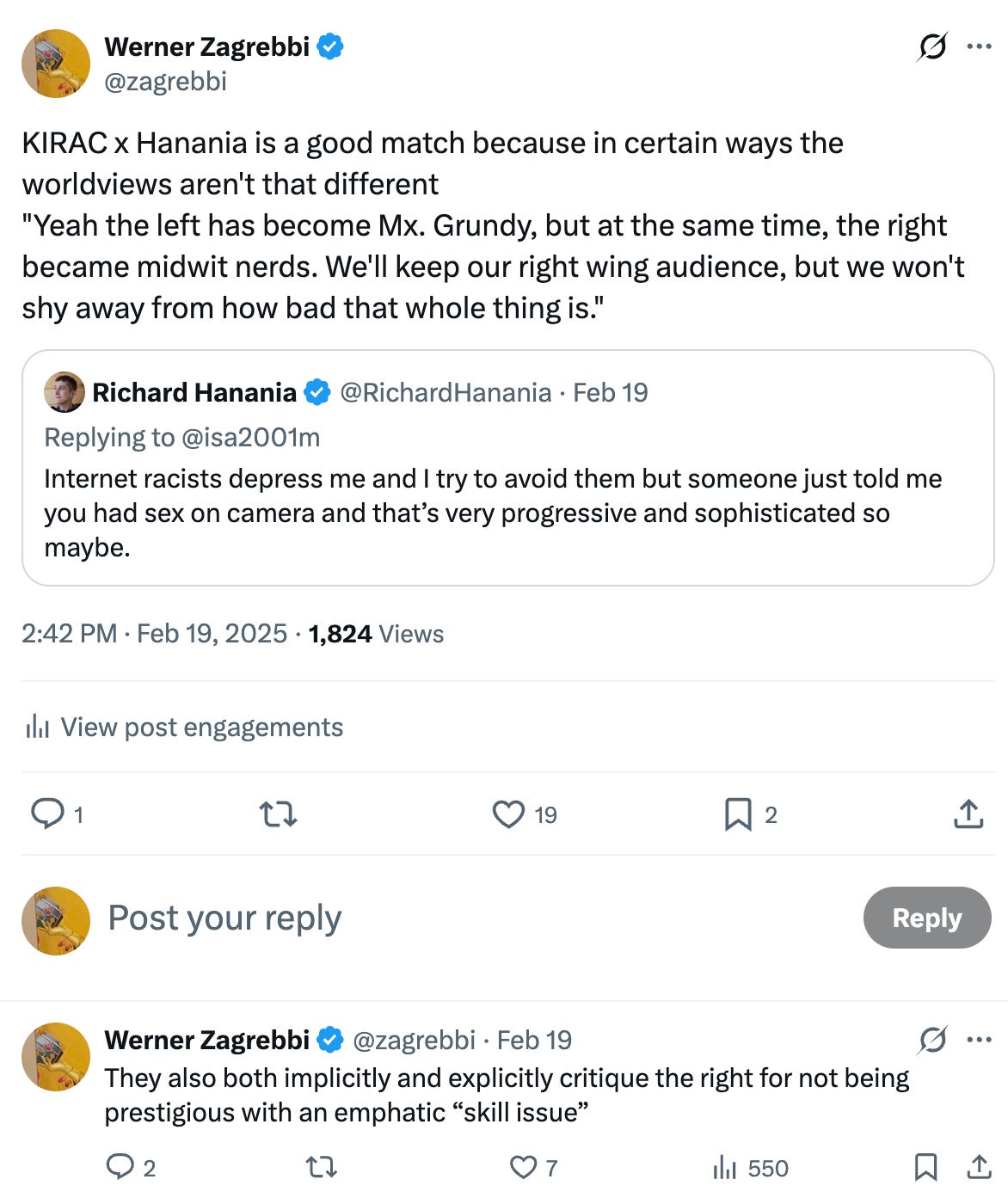
KIRAC as GiveWell?
I’ll wrap up with some brief emphasis that KIRAC’s project is so blatantly the quest to define a new aesthetic agenda for the 21st century. You can see this very clearly in their deeper cut The Goat: They take a wealthy, institutionally successful art patron and deliberately place him in extreme conditions like a Sacha Baron Cohen sketch, using the encounter explicitly to test whether a different, more “ennobling” model of art — one grounded in seriousness and commitment rather than irony and trade — can actually work. If newaesthetics.art is the Open Philanthropy of the cause of beauty, then KIRAC are not just the “mosquito nets.” They are also the GiveWell! They think about the quest for new aesthetics, they publicly explicate why, they look around in the art world for glimmers — a world they understand and document to a unique degree; they have the potential to embody the problem itself, to become associated with it, and make it more salient with the success of their art.
In many ways they’re advantaged over any piecemeal attempt at this cause area from SF, except financially. They’re actual working artists — Stefan was a working painter in Berlin before pivoting to film — they have a decade of documented fieldwork on the art world’s failure modes, and they can crack cultural codes illegible to rats. Bringing Henry Oliver to Mercatus, or a Stripe-adjacent version of the same, will not produce what KIRAC does natively. This is really a comparative-advantage case: They are the best people in the world to do this. And that’s without mentioning they’re actually pretty close themselves to Progress World indeed — plausibly closer than any other famous artists who haven’t been on CWT?!
When Stefan and his wife and partner Kate interviewed me, Stefan several times referenced Tyler’s In Praise of Commercial Culture (this was not from being friends with me they’re just extremely sophisticated observers of the contemporary world of ideas!); the video should be out in the next couple of weeks but something like “Tyler was very right to address in his book the pessimism in culture and art making, which is very dominant in the 20th century. And his book is a call for optimism, even optimism regarding the pessimism. And this challenged us to go deeper in this need for art to be fundamentally pessimistic or optimistic.”
You should find a few thousand dollars for these guys to meet Robin Hanson!
Our Ask
The KIRAC production function is an ongoing Platonic symposium. They set up shop in a new place and have conversations and encounters, they hold events, and record it all with a roving camera and ever present clip-on mics. This has many advantages: Fans are indubitably potential subjects and collaborators, and the whole process — with its inherent subculturality — seems rather robust indeed to AI. Naturally, though, KIRAC requires money for some very practical things: travel, lodgings, and equipment, and — being Europeans — it’s striking how hard money is to come by for them.
KIRAC’s success has been on an incredible shoestring: 100k a year, 2 people with young children working full time. I think there is an arbitrage here. Money for patron-strapped Europe would have a disproportionate effect.
Concretely, though: Along with editing the Houellebecq film, the other main KIRAC project is an as-yet-unnamed set of “ennobling portraits” of thinkers from the rationalist and effective altruist worlds, as well as scientists. This can be expanded to include, say, Samuel Hughes, Henry Oliver, Robin, and YOU! 50k would certainly be enough.
Something else Stefan and I discussed: It’s often fruitful to litigate Coasean boundaries of different sorts of enterprises — what should the distinction be between an academic department and a think tank, a think tank and a blog, a blog and a hedge fund etc. What about the distinction between a documentary and a conference? What would an unconference, designed to be filmed, be like? The idea has obvious advantages: Whereas conferences are essentially ephemeral, documentaries are durable. The possibilities are immense!
A New Aesthetics unconference could do for this cause area what MIRI’s early events did for alignment: create a shared vocabulary and network, and generate durable artifacts that outsiders can observe. We could invite every New Aesthetics grantee, along with Sam Hughes, Henry Oliver, Alice Evans, Ted Gioia, Owen Yingling, Zeynep Tufekci, and others — all the finest thinkers on the question of what a cultural, even a policy agenda in service of beauty would be like.
Let’s host this!
There’s a libertarian angle — it’s a story about a group of libertines winning their struggle against a chud
Elephant in the Brain’s chapter on the art world is an excellent companion text to ‘The Art of Simchowitz’. If Hanson showed that the fine art world’s stated purpose — the pursuit of beauty, meaning, even justice — is largely a cover for its real function: signaling wealth, taste, and status, Simchowitz is someone who fully understands this and refuses the customary deniability. He has fully internalized the logic of a system that officially disavows everything he represents (except for woke).
If you sell below market price, you create a queue, and the queue lets you choose your buyer. And that is the role of galleries, how they “place” works in collections that enhance the artist’s CV, and more cynically how they maintain the hierarchy that justifies their existence as gatekeepers rather than just shopkeepers.
And watch what institutions grow back around him!