

This one is short. But I thought it would be easy to write, and it was. As Cowen says, Never Stop Posting.

In 2024, after years of bureaucratic kangaroo trials, Amy Wax was suspended from Penn Law for various chudish statements. The most famous of these was from a September 2017 podcast interview with Glenn Loury:
As a wee lad, I recall listening to the pod when it came out. Other reactions were less enthused. Quote:
In response, Law School dean Theodore Ruger sent an email to the campus community on March 13 denying Wax’s claims and announcing her removal from 1L classes. “Black students have graduated in the top of the class at Penn Law”…
“In light of Professor Wax’s statements, black students assigned to her class in their first week at Penn Law may reasonably wonder whether their professor has already come to a conclusion about their presence, performance, and potential for success in law school and thereafter,” he added.
What hasn’t been clearly established in the nine years since, however, is whether Wax’s statements were true–and, as the only people with the data are Penn’s administration, this is set to remain the case unless Trump sues them.
But we can get close!
Dataaa
It’s pretty well established that the best law school is Yale, that Harvard and Stanford are a bit behind, and that Chicago is probably the best of the rest. The distinction of 5th-best law school is a lot more contested, but the traditional contenders are Columbia and to a lesser extent Penn and NYU.
Well, thanks to friend of the blog Cremieux, I happen to have on hand the full student-records database of Columbia Law!
Columbia—like most law schools—grades on a curve, and hands out its honors strictly off cumulative GPA. It’s trivial to reconstruct each JD graduating class from the registration data, rank within each class, and designate the top 25% by GPA the “top quarter.” The result is roughly 14,000 JD graduates going back to the 1980s.
Here is the decade before Wax’s statement—2007 to 2016.
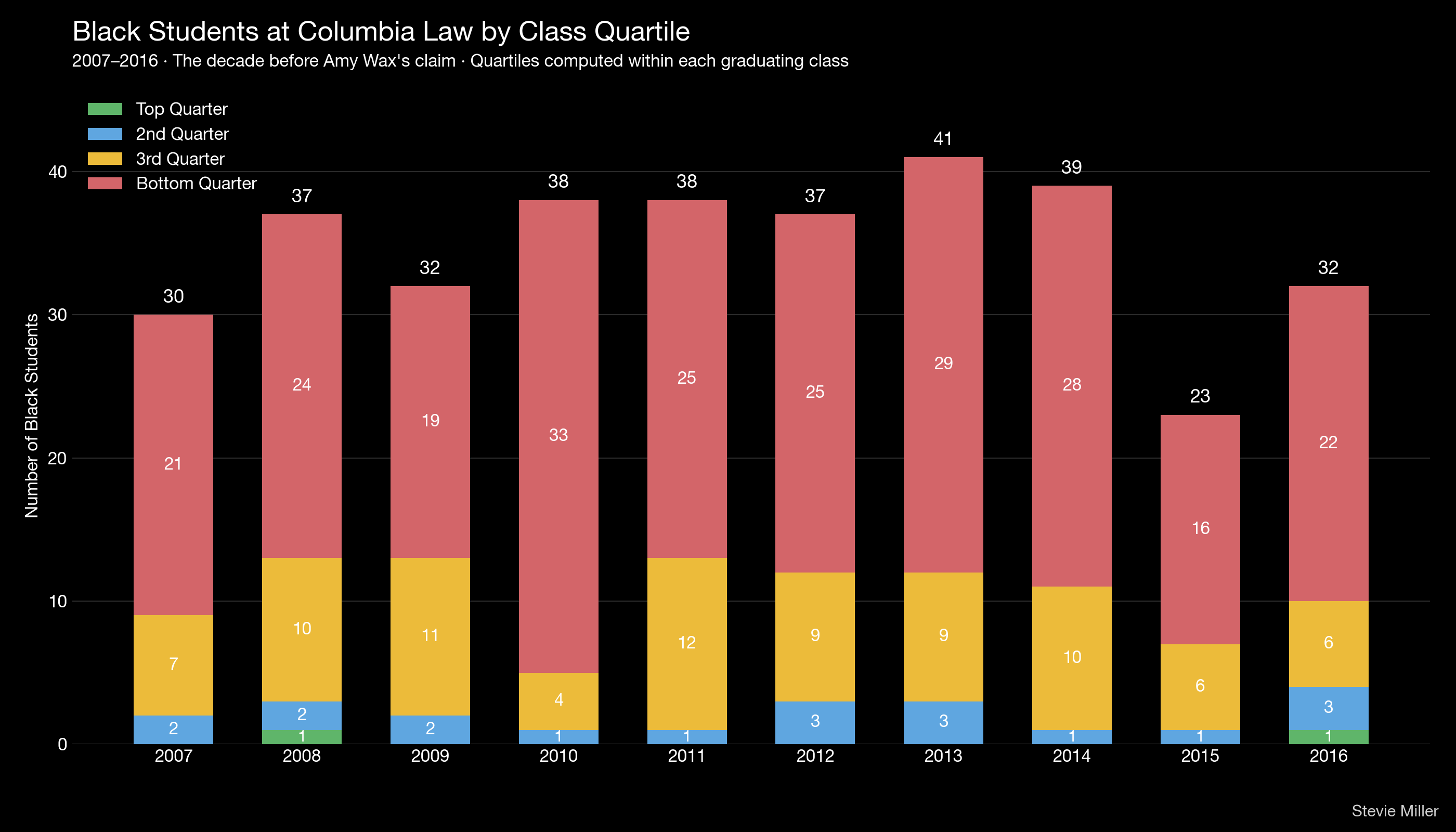
Over the period, there were 2 top quartile Black graduates at Columbia Law. If you take into account that Penn Law is half the size and slightly worse (thus doesn’t get the pick of the litter of smart Black law students), it’s entirely plausible there were literally zero Black students in Penn’s top quartile, and certainly reasonable a professor who taught a few sections a year could go a whole career without seeing one.
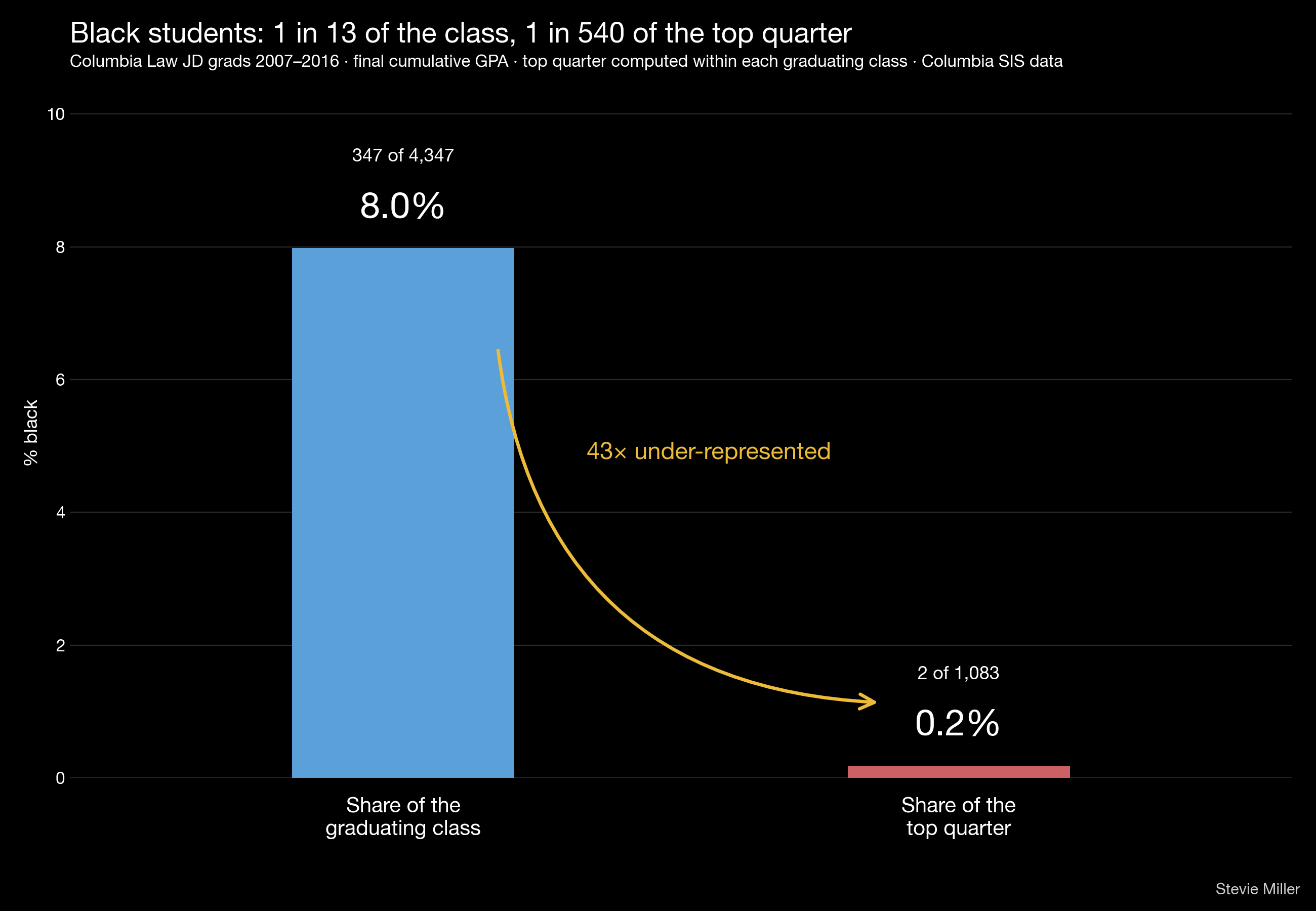
The same pattern stated the other way: Black students are about a tenth of the class and about two thousandths of the top quarter.
Isn’t this bad
The cordon sanitaire around the relevant facts of Affirmative Action—and social policy at large—had many victims. Penn Law’s best prof Amy Wax of course,1 and its intended victims (i.e., you), but also quite possibly everyone else.
Consider: UCLA’s Richard Sander is probably the pivotal figure of the social science of Affirmative Action. In 2004 he published a very well-defended paper in the Stanford Law Review: "A Systemic Analysis of Affirmative Action in American Law Schools".
Sander noticed that in the milquetoast National Longitudinal Bar Passage Study, roughly 45 to 50% of Black law students clustered in the bottom tenth of their first-year classes, a gap that disappeared entirely after controlling for LSAT scores and undergraduate GPA. The relevant variable, thus, is not race as such, but academic mismatch.
When the cream of Black law talent chooses Columbia instead of UGA School of Law, “[professors] aim instruction at the median student.” Weaker students “fall behind and learn less” and are fucked by the curve. When they graduate in bottom 5th of the class, it’s hard for them to get noticed.
Affirmative Action, Sander argues, may well reduce the total number of Black lawyers.2
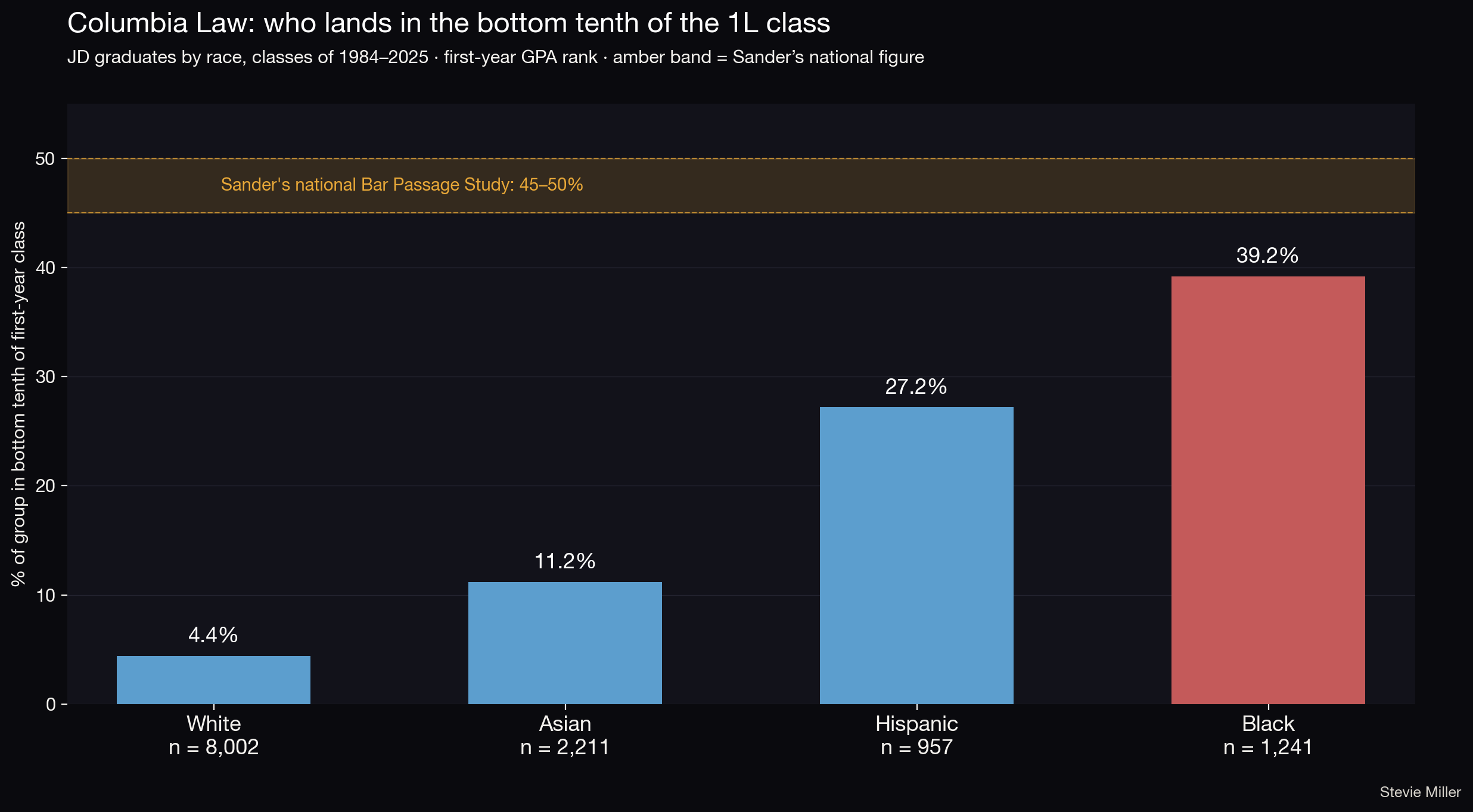
But the general trend was for no one in charge to really notice or care;3 maybe until SFFA but probably after too. After all, what percent of Americans know that Black students made up 0.2% of the top quarter of Columbia law?4
Said Sailer:
But … how many Americans know that?
Ivy League presidents know that. People who have carefully read The Bell Curve know that. People who followed the discovery process in SFAA vs. Harvard know that.
This exogenous neutering of the discourse (retardation—if you will) is clearly part of why it was so easy for the Supreme Court to put a lid on six decades of Affirmative Action.
Now, on a lot of questions, we should be open to 10% Less Democracy: Secret Congress, independent central banks, longer terms—of course these are good things and on the margin elites should have more power. Giving the first 2,000 people in the Boston phonebook control of monetary policy would just be terrible and it’s good normal people don’t have opinions about it.
But the 10% Less Democracy thesis has to have conditions. Elite influence “is most desirable when (a) the electorate is poorly informed about the optimal action, (b) acquiring decision-relevant information is costly, and (c) feedback about the quality of decisions is slow.” The Fed can be wrong, but inflation comes eventually and is public.
Affirmative Action is the bear case for Jones. The public is ignorant, yes, but in large part because the institutions with the relevant information made sure it stayed ignorant. The facts and outcomes were hidden between the pages of law reviews and in snippets of podcasts, enforced by a taboo so strong they threatened the normally unshakable protections of tenure.5 Not even the vast majority of elites had good information.
If we’re going to have good social policy for everyone, we must let near-elites be aware of the facts. On Affirmative Action, we need 10% more democracy.
Trump’s AG should go after Penn under Title VI. After SFFA, Penn's racial admissions preferences are themselves an unlawful practice—and Title VI's anti-retaliation rule protects anyone punished for opposing an unlawful practice. Wax did that: she pointed—publicly and accurately—at the racial outcomes those preferences produce, and for it Penn stripped her of her 1L teaching and docked her pay. Penn’s next drop of federal money should be conditioned on Penn producing their data, and putting Wax back in front of her students and restoring her grants.
The administration just ran this playbook on Penn over women’s sports—do it again for Professor Wax. That would send a message that we can finally have real debates about social policy.
Says La Wik: “After high school, Wax graduated from Yale University with a Bachelor of Science (B.S.) in molecular biophysics and biochemistry, summa cum laude, in 1975. She then was awarded a Marshall Scholarship to pursue graduate studies at the University of Oxford. She graduated from Somerville College, Oxford, in 1976 with a Master of Philosophy (M.Phil.) in philosophy, physiology, and psychology.[10][11][12]
Upon returning to the United States, Wax dual enrolled in Harvard Medical School and Harvard Law School. While studying as a medical student, she was a resident tutor in both medicine and philosophy at Eliot House within Harvard College. She earned her Doctor of Medicine (M.D.), cum laude, with distinction in neuroscience from Harvard Medical School in 1981. Concurrently, Wax was a first year student at Harvard Law from 1980 to 1981.[10][11][12]
Wax practiced medicine from 1982 to 1987, doing a residency in neurology at the New York Hospital-Cornell Medical Center and working as a consulting neurologist at a clinic in The Bronx and for a medical group in Brooklyn.[10][8] She completed her legal education at Columbia Law School, where she became an editor of the Columbia Law Review and was a Harlan Fiske Stone Scholar. She worked part-time to pay for her law school education, obtaining her Juris Doctor (J.D.) degree in 1987.[11][8] During her time as a law student at Columbia, Wax received two awards: the Emil Schlesinger Labor Law Prize and the Milton V. Conford Prize in Jurisprudence.[10][12]”
Of course at Columbia that is probably not the relevant margin. Still, the hierarchy suppressed at admissions surely reemerges inside the school for law review, placements, faculty attention etc.
Though—damn—isn’t it great to have the Supreme Court! This is the real Chud Veto. W Leonard Leo and W James Madison.
I recall a lecture in Quantitative Social Science II, the prof was explaining some math with Item Response Theory—”You never get a question where people who are more proficient do worse, so the slope of the ‘discrimination parameter’ is always positive.”
I don’t doubt this is typically the case Professor Patterson, but there are some trivia questions I can come up with that educated people do worse on.
I.e., you normally have to kill your wife to lose tenure. They tried really hard to do this to Amy Wax.
As someone who followed l'Affaire Wax from the beginning (from the Glenn Show episode onwards), I find this unsurprising but encouraging. This data longs to be free. Many thanks to yourself for packaging it, and the hacker for acquiring it in the first place.
Regarding Sander's paper, it's worth noting that Thomas Sowell made the same point in his 1990 book Preferential Policies: an International Perspective, pg. 84: https://ia600706.us.archive.org/21/items/politicsDEEPWEB/Preferential%20Policies_%20An%20International%20Perspective%20-%20Thomas%20Sowell.pdf.
Interview with him discussing the point: https://www.youtube.com/watch?v=VVvnTByzTmA.
And a later interview with Buckley on affirmative action, which mentions differences in IQ between different Jewish groups in the US and Israel: https://www.youtube.com/watch?v=eUbOcgj8AjQ.